
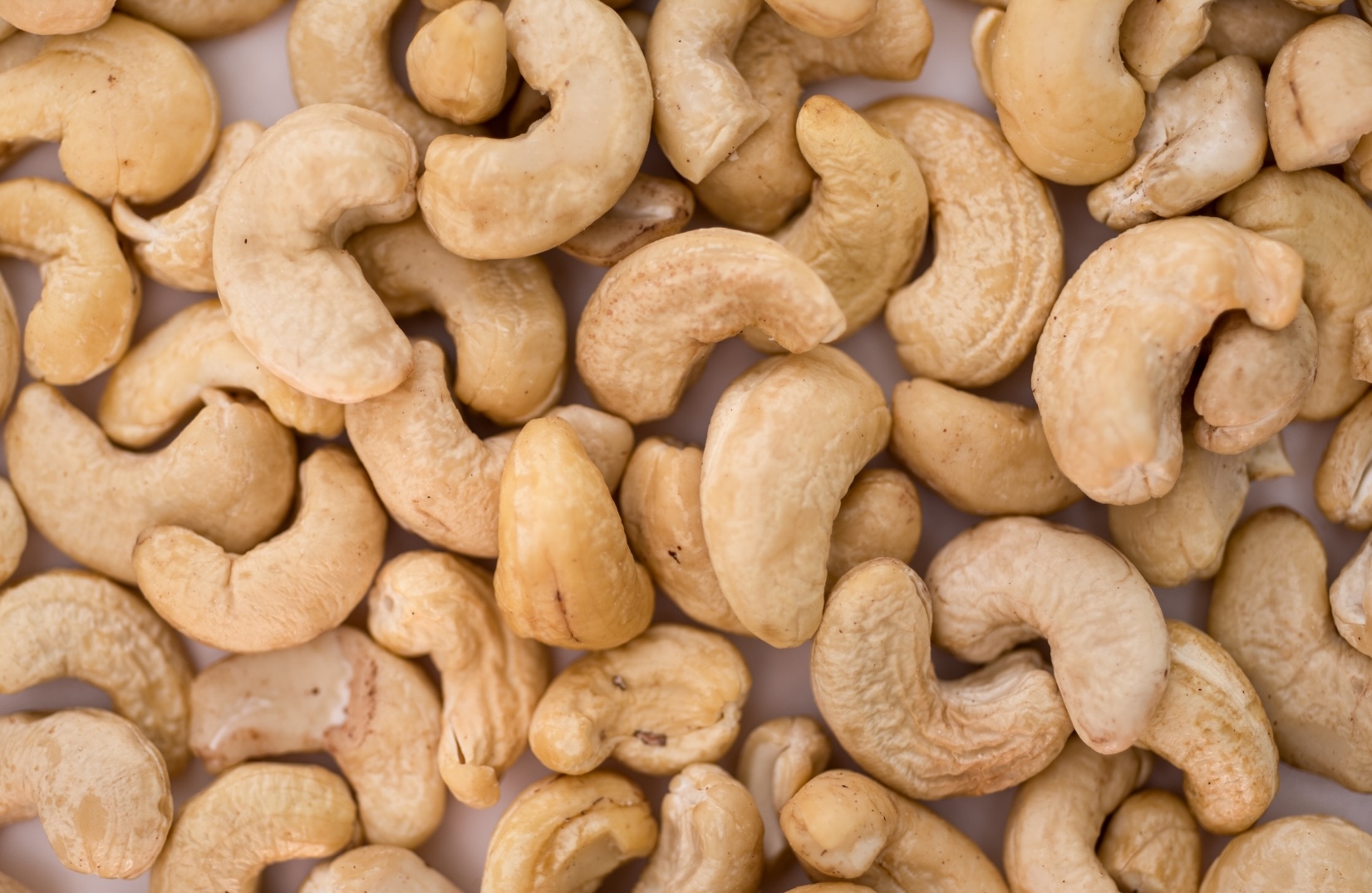
1. Applying AFI 2016 Cashew Kernel Specifications (HS 0801.32)
Under the Association of Food Industries (AFI) 2016 Standard, whole white (WW) cashew kernels are classified strictly by kernel count per pound (453.59g): W180 (170–180 kernels/lb | 266–395/kg), W210 (200–210/lb | 395–465/kg), W240 (220–240/lb | 485–530/kg), W320 (the global benchmark at 300–320/lb | 660–706/kg), and W450 (400–450/lb | 880–990/kg), alongside Scorched Wholes (SW), Butts (B), Splits (S), and Large White Pieces (LP — retained on a 4.75mm 4-mesh sieve).
Every purchase contract must mandate six quantitative release gates prior to container stuffing (700 cartons × 22.68 kg = 15.876 MT per 20' FCL or 1,100 cartons = 25.0 MT per 40' FCL): (1) Moisture: 3.0% to 5.0% max; (2) Free Fatty Acid (FFA): < 0.5% and Peroxide Value (PV): < 1.0 meq/kg; (3) Aflatoxin: < 4 ppb total (EU) or < 15 ppb (US); (4) Broken & Next-Lower-Size Allowance: strictly capped at < 5.0% max; (5) Foreign Matter: < 0.01%; and (6) Zero 'Hard Blocking' inside CO2/Nitrogen-flushed vacuum polybags.
2. Frozen Seafood (HS 0304.62 / 0306.17): AOAC Deglazing Checks & Phosphate Limits
In frozen Pangasius hypophthalmus fillets and Litopenaeus vannamei shrimp, two quality issues require clear pre-shipment checks: excessive protective ice glaze (for example, shipping 25% glaze against a 15% specification) and heavy soaking in Sodium Tripolyphosphate (STPP / E451), which increases water retention prior to freezing and leads to drip loss upon thawing.
Independent quality inspectors perform on-site AOAC Official Deglazing Net-Weight Tests directly on the Mekong Delta packing floor, verify the packer's active NAFIQAD / EU DL approval code and US FDA registration, and require accredited LC-MS/MS antibiotic-free laboratory clearance before container sealing.
3. Key Specifications & Summary Table
| Grade / Commodity | Count / Size Specification | Chemical & Moisture Limits | Key Quality Risk Prevented |
|---|---|---|---|
| Cashew W180 / W210 (Jumbo) | 170–180 / 200–210 kernels/lb | MC 3–5% | FFA <0.5% | Afla <4 ppb | Blending W240 into W210/W180 lots |
| Cashew W240 / W320 (Standard) | 220–240 / 300–320 kernels/lb | Lower-size <5% | Broken <5% | PV <1.0 | Blending W450 into W320 + Hard Blocking |
| Pangasius Fillets (Well-Trimmed) | 120–170g / 170–220g IQF | Moisture ≤83% | STPP ≤0.5% (or STPP-Free) | STPP over-soaking & 10% glaze short-weight |
| Vannamei Shrimp (HLSO / PDTO) | 16/20, 21/25, 26/30, 31/40 pcs/lb | 100% Net Weight Verified (AOAC Deglaze) | Count-jumping after glazing + antibiotic residue |
4. Frequently Asked Questions
Q1. What are the exact AFI 2016 specifications for Vietnamese W240 and W320 cashew kernels?
Under AFI 2016 standards, First Quality Fancy Whole White W240 must count 220–240 kernels per pound (485–530/kg) and W320 must count 300–320 kernels per pound (660–706/kg), with moisture between 3.0% and 5.0% max, Free Fatty Acid (FFA) < 0.5%, Peroxide Value < 1.0 meq/kg, broken kernels < 5%, next-lower-size grades < 5%, and foreign matter < 0.01%.
Q2. How do I prevent next-lower-size blending and hard blocking in Vietnam cashew imports?
Require an on-site pre-shipment sieve and count audit on random 22.68kg cartons after vacuum sealing (when ≥80% of the 15.876 MT container lot is packed) to check both kernel count per pound and vacuum pressure—ensuring bags are firm without crushing kernels into a fused 'hard block.'
Q3. How do I audit net deglazed weight and STPP phosphate moisture retention in Vietnamese pangasius and vannamei shrimp?
Specify '100% Net Deglazed Weight per AOAC Official Method' in your purchase contract, cap tissue moisture (≤82%–83% for Pangasius) and phosphate levels, verify the processor's NAFIQAD / EU DL plant code, and mandate an on-site water-bath deglazing weigh-in prior to reefer loading.