
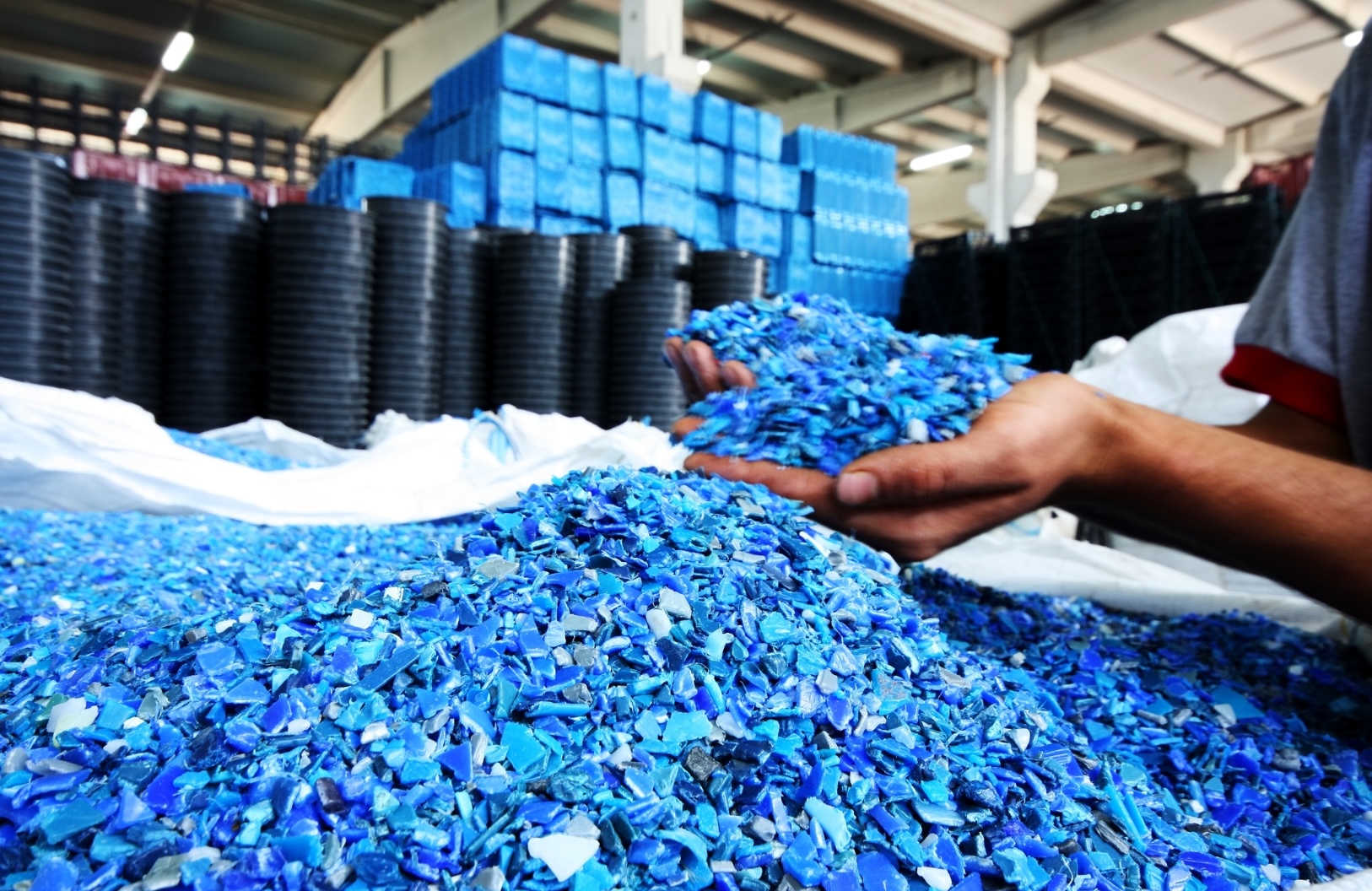
1. GRS 4.0 rPET Flakes & SSP Food-Grade Pellets (HS 3907.61 / 3915.90)
Vietnam's leading polymer recyclers in Đồng Nai, Long An, and Bình Dương operate Austrian/German Starlinger and EREMA Solid State Polymerization (SSP) bottle-to-bottle decontamination lines holding US FDA Letters of No Objection (LNO) and EFSA approvals. However, procurement teams must distinguish between a factory's annual GRS 4.0 Scope Certificate (SC) and a shipment-specific GRS Transaction Certificate (TC). Only a lot-tied TC issued by the certification body (e.g., Control Union, Intertek, IDFL) after auditing input bale mass-balance and the plant's MONRE environmental permit proves your container contains certified post-consumer recycled resin.
Mandatory pre-shipment laboratory parameters include: Intrinsic Viscosity (IV): 0.72–0.84 ± 0.02 dL/g (per ASTM D4603); Moisture: < 0.5% for hot-washed flakes and < 0.02% for SSP pellets; PVC Contamination: < 15–30 ppm (oven bake test); Polyolefin / Metal / Glue: < 20 ppm; Acetaldehyde (AA): < 1.0 ppm for beverage preforms; and CIE L*a*b* color coordinates (L* > 65–72, b* < 1.5).
2. Yen Bai & Nghe An CaCO3 Filler Masterbatch (HS 3824.99): Particle Size & Ash Burn-Off
Northern Vietnam's Yên Bái and North-Central Nghệ An provinces possess some of the world's purest white calcium carbonate marble deposits (CaCO3 purity ≥ 98.5%, whiteness ≥ 96%–98%). Compounded on twin-screw extruders with PP homopolymer, LLDPE, or HDPE virgin carrier resins (25–28 MT per 20' FCL heavy payload), Vietnamese CaCO3 masterbatch significantly reduces raw polymer costs in raffia woven sacks, blown film, and injection molding.
To prevent web breaks, die-lip buildup, or film 'lensing,' buyers should audit four laboratory metrics on every production lot: (1) Ash Content (ISO 3451 / ASTM D5630 burn-off): verifying exact 75%–85% ± 1% CaCO3 loading vs. virgin carrier resin; (2) Laser Diffraction Particle Size Distribution (PSD): median D50 = 1.2–2.5 μm and top-cut D97 ≤ 8–10 μm for thin film; (3) Melt Flow Index (MFI per ASTM D1238); and (4) Karl Fischer Moisture: strictly < 0.10%.
3. Key Specifications & Summary Table
| Polymer Product Grade | Key Physical / Rheological Spec | Contamination / Purity Limit | Mandatory Certification & Test Method |
|---|---|---|---|
| SSP Food-Grade rPET Pellets | IV: 0.78–0.84 ±0.02 dL/g | MC <0.02% | AA <1.0 ppm | PVC <15 ppm | L* >68 | GRS 4.0 Lot TC + US FDA LNO / EFSA + ASTM D4603 |
| Hot-Washed Clear rPET Flakes | IV: 0.72–0.78 dL/g | MC <0.50% | PVC <25 ppm | Polyolefin <20 ppm | GRS 4.0 Lot TC + MONRE Permit + Oven Bake Test |
| PP Raffia CaCO3 Masterbatch | 80%–85% CaCO3 | MFI 2–5 g/10min | D50: 2.0–2.5μm | D97 ≤12μm | MC <0.1% | ISO 3451 Ash Burn-Off + Laser PSD + REACH |
| LLDPE/HDPE Film Masterbatch | 75%–80% CaCO3 | MFI Matched | D50: 1.2–1.6μm | D97 ≤8μm | White ≥97% | Karl Fischer Moisture <0.08% + FDA Food Contact |
4. Frequently Asked Questions
Q1. Where are the leading CaCO3 filler masterbatch and rPET recycling factories in Vietnam?
Quarry-integrated CaCO3 filler masterbatch plants are concentrated in Northern Vietnam around Yên Bái, Hà Nam, Hải Phòng, and Nghệ An near high-purity white marble deposits. Advanced hot-washed rPET flake and Starlinger/EREMA SSP food-grade pellet plants are concentrated in Southern Vietnam across Đồng Nai, Long An, and Bình Dương near Ho Chi Minh City ports.
Q2. How do I verify a Global Recycled Standard (GRS) Transaction Certificate from a Vietnamese polymer supplier?
Never accept an annual GRS Scope Certificate (SC) alone. Require a shipment-specific GRS 4.0 Transaction Certificate (TC) issued by the accredited certification body (such as Control Union or Intertek) referencing your exact Commercial Invoice, Bill of Lading, and net metric tonnage, and cross-verify its QR/reference code on the Textile Exchange database.
Q3. What technical parameters should be tested when importing CaCO3 masterbatch from Yen Bai or Ha Nam, Vietnam?
Mandate four pre-shipment laboratory checks on composite bag samples: (1) ISO 3451 / ASTM D5630 Ash Content burn-off to verify the exact CaCO3-to-virgin-resin ratio; (2) Malvern laser diffraction particle size distribution (D50 and D97 top-cut); (3) ASTM D1238 Melt Flow Index (MFI); and (4) Karl Fischer moisture (<0.10%).